
Dear Kendall Square…Sincerely, Mr. Ecclesiastes
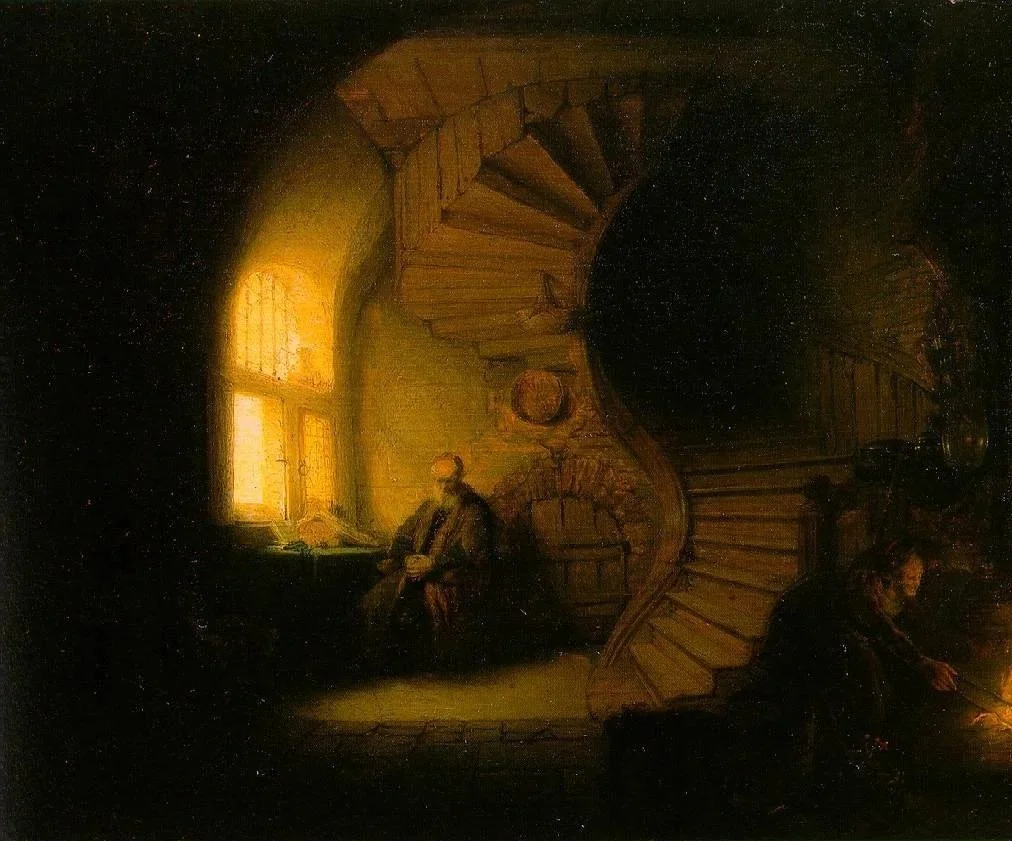
Philosopher in Meditation, Rembrandt van Rijn (c. 1632)
In recent conversations with members of the MIT community, one of the most frequent topics that surfaced was transitions. This makes sense, given that we’re in the month of May—a season marked by graduations, relocations for new careers, weddings, and the beginning of new chapters of life. At the same time, however, other conversations reminded me that there is an entirely different group of people for whom transition is not the dominant experience. Quite the contrary. The rhythms of MIT’s 9-to-5 office and lab culture require working professionals to remain faithfully at their posts. Parents are still called to be parents. Others continue the daily work of caring for loved ones battling prolonged illnesses, maintaining consistency and attentiveness through demanding routines.
As another academic year comes to a close amid this wide range of life circumstances, I found myself wondering what sort of reflection might speak meaningfully to everyone in our community. In this essay, I want to draw on biblical wisdom to consider what it means to be human, and from there reflect on some of these shared experiences. As a student of the Hebrew Bible/Old Testament, Mr. Ecclesiastes (my personified figure of the book of Ecclesiastes) comes to mind. What might Mr. Ecclesiastes say after spending time around Kendall Square in the month of May? What, if any, sort of exhortations might he bequeath to our community?
Before diving into these questions, it would be fitting to start by understanding our audience more deeply. Mr. Ecclesiastes would notice, I presume, that most people undergoing transitions are juggling complex emotions. In one moment, he witnesses people’s smiles widen as they chatter excitedly about new opportunities for personal development, new communities to join, new cities to explore. In another moment, among the very same group, he hears anxieties and fears emerge. Some are concerned about having to redefine their identity as they leave familiar environments behind. Others feel overwhelmed by the lack of a clear roadmap for what comes next, or by the prospect of having to “start all over again” in a new place.
As for the second group, Mr. Ecclesiastes’ keen eye might observe people struggling with the slowness and familiarity of routine life, or wrestling to find meaning and purpose in repetitive schedules. Still, he would likely also notice a small pocket of people quietly thriving within those steady rhythms. In short, the season inaugurated by the month of May is a wide and varied one—one in which we can all benefit from a sprinkle of wisdom.
“So, what d’ya got, Mr. E? Anything helpful for us?” I would ask. At this point, I envision Mr. Ecclesiastes’ eyes closed, a subtle crease forming between his brows, as he nods gently in a shared understanding of the spectrum of life experiences. In the spirit of Ecclesiastes, I believe he would respond with a soft smile and say, “Be joyful, do good as long as you live, delight in his portion for you” (Ecc 3:12–13, 5:18–19), and “Fear God, and keep his commandments” (Ecc 12:13).
“Whether you’re thriving like King Solomon–with your own version of immense prosperity, international prestige, and intellectual renown—or just barely making it like Job—loss of wealth, livelihood, loved ones, and surrounded by confusion—life is composed of seasons,”[1] I hear him say. “And throughout all seasons, the best thing I have learned to do is fear the LORD and keep his ways.” Or in Jesus’ words, “Abide in me, and I in you…Abide in my love. If you keep my commandments, you will abide in my love, just as I have kept my Father’s commandments and abide in his love. These things I have spoken to you, that my joy may be in you, and that your joy may be full” (Jn 15:4, 9–11). That is to say, I believe that one way of understanding what it means to be human and to experience human flourishing—from the Christian worldview—is living in humble submission to God’s authority, while learning to enjoy the full experience along the way.
Thriving Through Transitions
So, to those enjoying a season of transition, we might imagine Mr. Ecclesiastes encouraging them to delight in the portion God has given them. “Congratulations! You [insert your proud accomplishment] and are about to embark on a new chapter of life. Celebrate! Receive this season as a gift and enjoy it fully.” Yet we can also expect from him a gentle word of caution: do not disillusion yourselves into thinking this season of rejoicing will last forever. This is not to rain on anyone’s parade, but simply to remind one of the higher reality that life is composed of many seasons. And through them all, we are exhorted to abide in him.
Working Through Transitions
For friends and community members navigating the anxieties and fears that often accompany new beginnings, I’m reminded of one particular line from Mr. Ecclesiastes’ reflection on seasons: “a time to plant, and a time to pluck up what is planted” (Ecc 3:2b). Many of us naturally prefer stability and familiarity over change. In the language of Ecclesiastes, some of us would rather remain planters than transition into becoming reapers. Yet it would be difficult to deny that enjoying the fruit of one’s labor is deeply rewarding. To refuse the season of reaping is to miss out on something meaningful.
In other words, the familiarity and efficiencies we develop during seasons of “planting” can certainly provide a sense of productivity and fulfillment. Yet the experience of reaping—of finally enjoying the fruit cultivated through prior labor—is an altogether different kind of joy, one that the earlier season alone could never provide. Indeed, transitions can introduce discomfort. Still, I believe that the discomforts that accompany new beginnings often pale in comparison to the joy we experience.
Working Through Routines
For those currently working through routines, and fighting to find purpose—wondering if anything meaningful is taking place or if things are improving when circumstances do not appear to be—I’m reminded of Mr. Ecclesiastes saying, “Cast your bread upon the waters, for you will find it after many days. Give a portion to seven, or even to eight, for you know not what disaster may happen on earth” (Ecc 11:1–2). Initially, these verses can be a bit puzzling for the modern reader. When gleaning from other parallel ancient wisdom literatures,[2] we learn that the aphorisms essentially state that when one sacrifices something precious for the sake of another’s benefit, the favor will eventually return.[3] Faithfulness in the mundane, indeed, is not an easy task. However, in Mr. Ecclesiastes’ retrospection of his life experiences, your labor is not meaningless, even when its fruit remains unseen.
Thriving Through Routines
And lastly, for those enjoying a season of shalom in their steady routines, I imagine that Mr. Ecclesiastes would share the same sentiment for those thriving in transitions. “Enjoy your season! But also take heed that you’re mindful of the ebb and flow of seasons.”
Through every season, in every high and every low, may we experience deeper human flourishing by heeding Mr. Ecclesiastes’ exhortation—to fear God and keep his commandments always, and humbly enjoy the portions allotted to us. May the lyrics of the famous hymn, It Is Well, truly be our anthem:
When peace like a river attendeth my way,
When sorrows like sea billows roll;
Whatever my lot, thou hast taught me to say,
“It is well, it is well with my soul.”
[1] Ecclesiastes 3:1–8.
[2] From the Egyptian wisdom literature Instruction of Ankhsheshonq and Ben Sira 29:11–13.
[3] See Fox, Michael V. The JPS Bible Commentary: Ecclesiastes. 1st ed. Jewish Publication Society, 2004, 72.